You know these four words mean something close to "communicate," but every time you pick one, it feels like a coin flip. Here's the thing: tell, say, speak, and talk each follow specific patterns, and once you see those patterns, the coin flip disappears. This guide gives you a decision tree, 4 grammar rules, and real dialogues so you can stop guessing.
Quick definition: To tell (past tense: told) means to give information or instructions directly to a specific person. In Chinese, it translates most closely to 告诉 (gàosù). It almost always requires an object — you tell someone something.
Key Takeaways
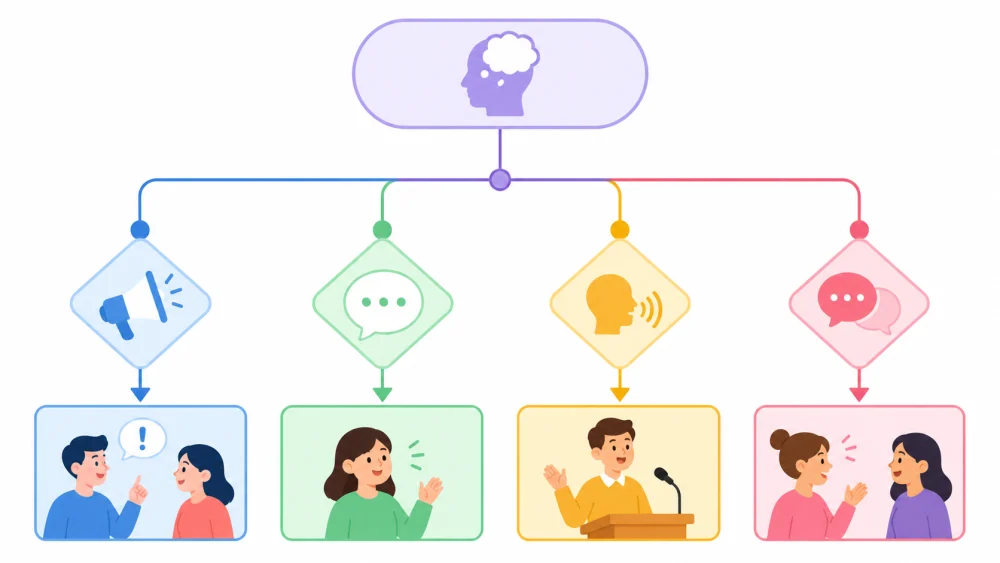
- Tell needs a listener. You always tell someone.
- Say focuses on the words themselves. You say something.
- Speak sounds formal and usually describes the act of producing speech or knowing a language.
- Talk is casual and implies a two-way conversation.
- Fixed phrases like "tell the truth" and "say goodbye" break the normal rules — memorize them separately.
What Does Each Word Actually Mean?
Tell — You Need a Listener
Tell is the only one of these four verbs that demands a person right after it. You tell her. You tell the class. You tell your mom. Without that listener, the sentence breaks.
Think of tell as handing someone a package of information. The package has a recipient baked in.
Say — You Focus on the Words
Say zeroes in on the actual words or message. "She said hello." "He said that he was tired." Notice how no person sits between "said" and the message? That's the key difference from tell.
You can add a person, but only with "to": "She said something to me." Never "She said me something."
Speak — It Sounds a Little Formal
Speak carries a formal weight. A professor speaks at a conference. You speak a language. The president speaks to the nation. It works best when the communication flows mostly in one direction or when you want to sound polished.
Talk — It Goes Both Ways
Talk is the everyday, kitchen-table verb. Two friends talk. Coworkers talk about a project. It implies back-and-forth — a conversation, not a lecture. If speak wears a suit, talk wears jeans.
How to Pick the Right Word Every Time (A Simple Decision Tree)
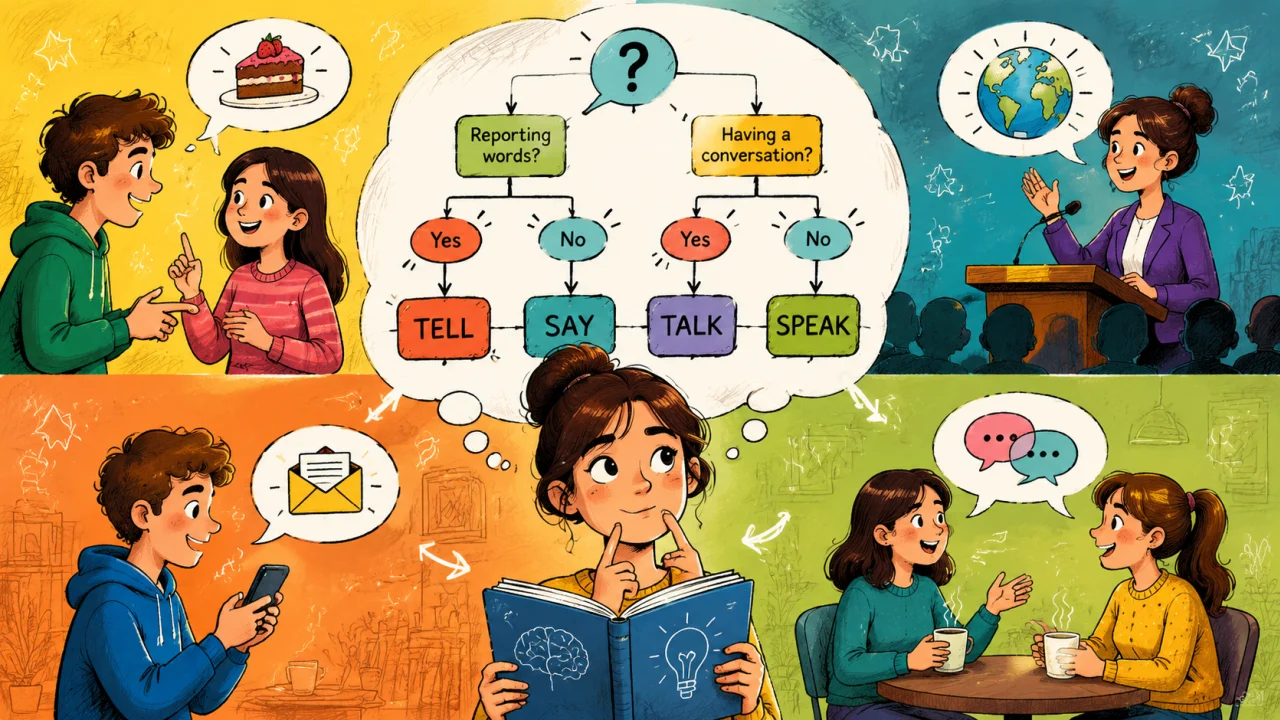
Run through these four steps in order. The first "yes" gives you your verb.
Step 1: Are You Giving Information to a Specific Person?
Yes? Use tell. "I told Jake the news." The information moves from you to a named (or implied) listener.
Step 2: Are You Quoting or Repeating Exact Words?
Yes? Use say. "She said, 'I'll be there at 3.'" Say is your go-to for direct and indirect quotes.
Step 3: Is It a Formal or One-Way Situation?
Yes? Use speak. "The dean will speak at commencement." One person addresses a group, or you're describing language ability: "He speaks Mandarin."
Step 4: Is It a Casual Back-and-Forth Chat?
Yes? Use talk. "We talked for two hours last night." Two or more people bouncing ideas around.
4 Grammar Rules That Make Tell Different from Say
Rule 1: Tell Almost Always Needs an Object (Tell Someone)
This is the rule that trips up the most learners. You can't just say "He told that he was leaving." You need a person in there: "He told me that he was leaving."
Rule 2: Say Never Takes a Person as a Direct Object
Flip side of Rule 1. "She said me the answer" is always wrong. It's either "She said the answer" or "She told me the answer."
Rule 3: Fixed Phrases Break the Pattern — Memorize These
English loves exceptions. Here are the big ones where tell drops its object requirement:
- Tell the truth
- Tell a lie
- Tell a story
- Tell the time
- Tell the difference
- Tell a joke
And say has its own fixed friends: say goodbye, say sorry, say a prayer, say a word.
No shortcut here. Flashcards work. Write each phrase on a card and drill them until they feel automatic.
Rule 4: Reported Speech Changes Which Word You Use
When you report what someone said, both tell and say work — but the structure changes.
- Say: "She said (that) she was tired."
- Tell: "She told me (that) she was tired."
See the difference? Tell inserts a person. Say doesn't. The meaning stays the same, but the grammar shifts.
Tell vs Say vs Speak vs Talk — Side-by-Side Comparison Table
| Feature | Tell | Say | Speak | Talk |
|---|---|---|---|---|
| Needs a person after it? | Yes (usually) | No | No | No |
| Used for quotes? | Rarely | Yes | No | No |
| Formality | Neutral | Neutral | Formal | Informal |
| Direction | One-way | One-way | One-way | Two-way |
| Common preposition | tell + person | say + to | speak + to/with/at | talk + to/about |
| Example | Tell me your name. | Say hello. | Speak clearly. | Talk to your friend. |
Common Mistakes You Are Probably Making Right Now
Saying "He Told That" Instead of "He Said That"
This is the #1 error in American ESL classrooms, according to grammar workbooks like Understanding and Using English Grammar by Betty Azar (first published in 1970). If there's no person after tell, switch to say.
Wrong: "He told that the store was closed." Right: "He said that the store was closed." / "He told us that the store was closed."
Mixing Up "Talk to" and "Speak with" in Emails
Are you writing a work email? "I'd like to speak with you" sounds professional. "I wanna talk to you" sounds like you're about to start an argument. Context matters. For job-related emails in the U.S., "speak with" is the safer pick.
Using Say When You Mean Tell in Indirect Speech
"She said me to wait" is wrong. You need tell here: "She told me to wait." Whenever you're giving someone an instruction, tell is the verb that fits.
Real Dialogue Examples You Can Practice Out Loud
Read these out loud. Seriously — hearing yourself use the right verb builds muscle memory faster than silent reading.
At School
- "Can you tell me where the library is?"
- "The teacher said, 'Open your books to page 42.'"
- "We need to talk about your grade on the midterm."
At a Store
- "Tell me about this laptop's battery life."
- "The salesperson said it lasts 10 hours."
- "I spoke with the manager about a return."
On the Phone
- "I need to talk to you about Saturday."
- "She told me she can't make it."
- "He didn't say why he canceled."

Phrasal Verbs and Idioms Most Learners Skip
Here's a contrarian take: memorizing phrasal verbs with tell, say, speak, and talk matters more than memorizing grammar rules. Why? Because native speakers in the U.S. use these phrases constantly, and no decision tree will help you decode them on the fly.
Tell Apart, Tell Off, Tell On — What They Really Mean
- Tell apart: Distinguish between two things. "I can't tell the twins apart."
- Tell off: Scold someone. "His boss told him off for being late." (More common in British English, but Americans understand it.)
- Tell on: Tattle. "She told on her brother." This one lives mostly in elementary school, but adults use it playfully too.
Say vs Speak in Idioms Like "Say the Word" and "Speak Up"
- Say the word: Give permission or signal. "Just say the word and I'll order pizza."
- Speak up: Talk louder, or voice your opinion. "If you disagree, speak up."
- Talk someone into: Persuade. "She talked me into buying the red one."
Why Pronunciation Matters More Than You Think
How to Pronounce Tell (/tɛl/) Without Sounding Like "Tail"
The vowel in tell is /ɛ/, like the "e" in "bed." It's short and crisp. If you stretch it into /eɪ/, you'll say "tail" instead. Practice by pairing it: "bed, tell, red, fell." Keep the vowel in the same pocket of your mouth.
The Stress Trick: How Native Speakers Emphasize These 4 Verbs Differently
When Americans stress tell in a sentence, it usually signals correction or surprise. "I told you so" hits differently than "I told you so." The first stresses that the telling happened. The second stresses who received the information. Pay attention to which word carries the weight — it changes the meaning without changing a single word.
FAQ
What is the difference between tell and say with examples?
Tell requires a person after it: "She told me the news." Say focuses on the words: "She said the news was bad." Use tell when directing information to someone specific; use say when reporting the content itself.
Can you use tell without an object?
Only in fixed phrases like "tell the truth," "tell a lie," "tell the time," and "tell a story." Outside these set expressions, tell needs a person as its object. Dropping it makes the sentence grammatically incorrect.
Is it speak to or speak with?
Both are correct. "Speak to" can imply a one-directional conversation (like a boss addressing an employee), while "speak with" suggests a mutual exchange. In American English, "speak with" is more common in professional settings.
When should I use talk instead of speak?
Use talk for casual, everyday conversations. "We talked about the movie." Use speak for formal situations, public addresses, or language ability: "She speaks three languages." Talk implies a relaxed two-way exchange; speak implies something more polished.
How do you use tell in reported speech?
In reported speech, tell always takes a person: "He told me that the meeting was at noon." Compare with say: "He said that the meeting was at noon." The meaning is identical, but tell needs that listener slotted in after it.
What does tell mean in Chinese?
Tell translates to 告诉 (gàosù) in Chinese. Like the English verb, 告诉 directs information toward a specific person. "Tell me your name" becomes "告诉我你的名字." The structural parallel makes this pairing relatively intuitive for Chinese-speaking learners.