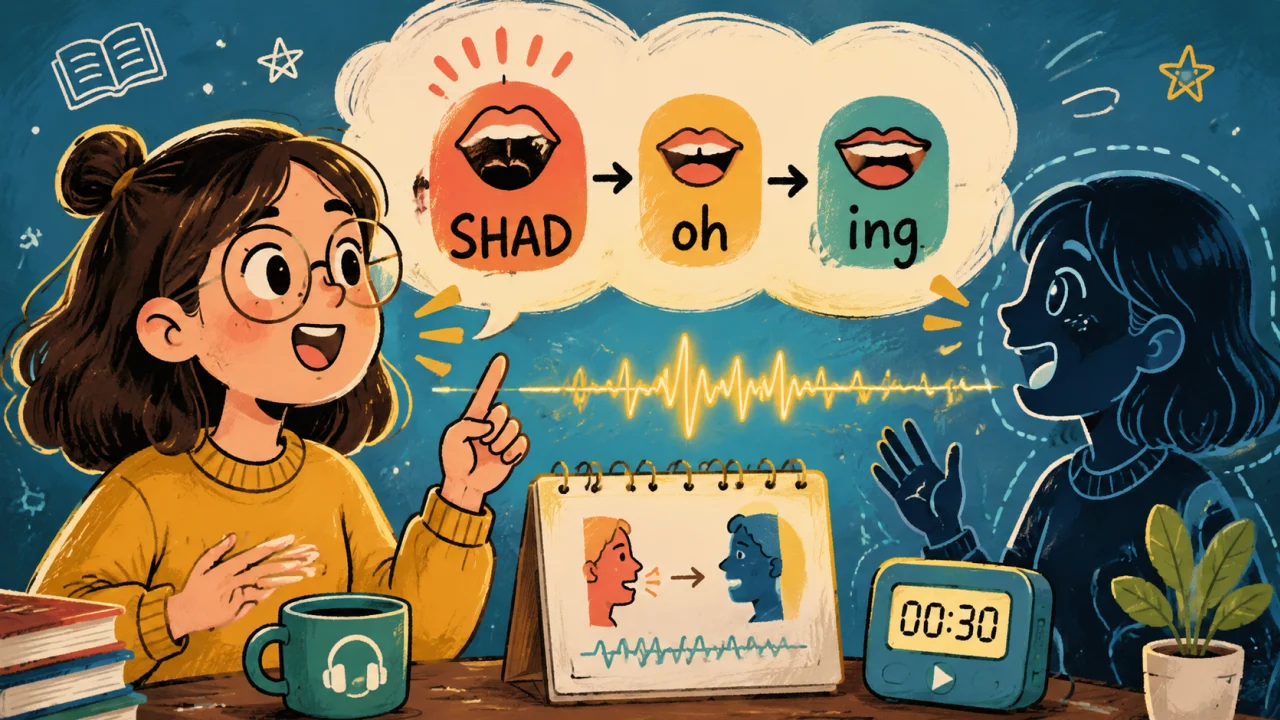
You've seen the word "shadowing" plenty of times, but the moment you need to say it out loud, you second-guess yourself. Here's the answer: SHAD-oh-ing — three syllables, stress on the first. In IPA notation, that's /ˈʃæd.oʊ.ɪŋ/. Now let's make sure you can actually feel it roll off your tongue.
Break It Down Syllable by Syllable
Three pieces. That's it. Say each one slowly, then string them together.
Syllable 1 — SHAD
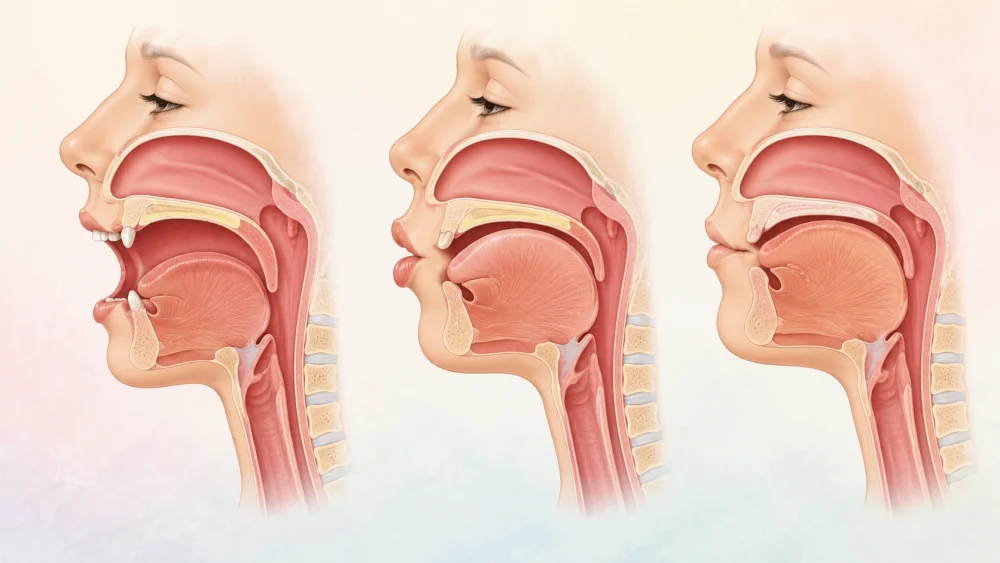
This is the dominant syllable — loudest, longest, highest in pitch. The vowel is a short "a," the same one in "cat," "had," or "grab." Drop your jaw slightly and spread your lips like you're starting to smile but stopped halfway. Your tongue sits low and flat.
Because SHAD carries the primary stress, you'll spend more time on it than on the other two syllables combined. Rush through it and the whole word sounds wrong.
Syllable 2 — oh
This is where most people slip. The second syllable isn't "ow" like in "cow" or "pow" — it's "oh," the same diphthong you use in "go" or "no." Phonetically, it's /oʊ/. Your lips round into a small circle and then close slightly as the sound trails off.
The most common mistake here: flattening it into "uh," so the word comes out as "SHAD-uh-ing." That's not right. Keep those lips rounded. Think about how you already say "shadow" — that second syllable doesn't change just because you're tacking on "-ing."
Syllable 3 — ing
You know this one from "running," "singing," and hundreds of other English words. One key detail: the final "g" isn't a hard stop. You don't pop it the way you'd pop the "g" in "get." Instead, the back of your tongue presses up against your soft palate — the soft tissue at the very back of the roof of your mouth — and holds there. Air moves through your nose. That's the nasal /ɪŋ/.
Put it all together: SHAD (loud, stressed) + oh (rounded lips, medium volume) + ing (soft, nasal finish). Say it three times fast and you've got it.
How "Shadowing" Sounds in American vs. British English
Most pronunciation pages give you one audio clip and move on. But if you've compared the UK and US recordings on Cambridge Dictionary, you'll notice they're not identical.
The difference lives in that second syllable. American English speakers produce a rounder, fuller /oʊ/ — lips push forward, and the sound glides from "oh" toward a soft "oo." British speakers tend toward something closer to /ɒʊ/, where the starting point of the vowel sits further back in the mouth.
Does it matter which version you use? Not really — both are correct. But if you're in the U.S. or speaking mostly with American English speakers, the rounder version will sound more natural. If you're aiming for a British accent, pull that vowel slightly back. Either way, the stress stays on SHAD and the syllable count stays at three.
Now Use the Shadowing Technique on the Word Itself
Here's the twist most pronunciation articles miss: "shadowing" isn't just a word to say correctly — it's also the name of one of the most effective pronunciation techniques around. Shadowing means listening to a short audio clip and repeating what you hear in near-real-time, matching the speaker's rhythm, stress, and intonation. VOA Learning English describes it as finding a clip that's 30 seconds to 2 minutes long and speaking right along with it.
So why not practice the technique on the word itself? Here's a 3-step drill:
Step 1: Pull up a pronunciation clip. YouGlish has over 870 examples of real speakers using "shadowing" in context. Pick one. Or watch the VOA Learning English pronunciation video published in January 2023, which covers this exact word.
Step 2: Listen once without saying anything. Pay attention to where the stress falls and how quickly the speaker moves through each syllable.
Step 3: Play it again and speak along — not after, but with the speaker, like a shadow. Match their speed. Match their volume on that first syllable. If you're off, rewind and go again.
This feels odd the first time. That's expected. The whole point is training your mouth to move the way a fluent speaker's does, not just recognizing the word in your head.

Common Mistakes When Saying "Shadowing"
Three errors come up repeatedly — and none of them get covered in the video results that dominate search for this topic.
Mistake 1: Stressing the wrong syllable. Some speakers say "sha-DOW-ing," punching the second syllable hard. It splits the word into two awkward pieces instead of one smooth unit. Fix it by making SHAD the loudest part and letting everything after it get quieter.
Mistake 2: Using the "ow" from "cow." If you say "SHAD-oww-ing" with the vowel from "how" or "now," you've got the wrong sound. The correct vowel is the "oh" from "go." Wrong: SHAD-oww-ing. Right: SHAD-oh-ing.
Mistake 3: Dropping the final nasal entirely. In casual American conversation, "shadow-in" sneaks by. You'll get away with it in small talk. But in a presentation, a class, or any recording, keep that tongue pressed to the soft palate for the full /ɪŋ/.
"Shadow" vs. "Shadowing" — Does Adding "-ing" Change the Pronunciation?
Good news: barely. "Shadow" is 2 syllables — SHAD-oh. "Shadowing" is 3 syllables — SHAD-oh-ing. The stress stays on the first syllable in both words, and none of the vowel sounds shift. You're just adding /ɪŋ/ to the end.
That's worth knowing because English doesn't always play it this straight. Take "photograph" versus "photography" — the stress jumps from the first syllable to the second the moment you add that suffix. Or think about "record" as a noun (RE-cord) versus "record" as a verb (re-CORD). English is full of those traps. "Shadow" to "shadowing" isn't one of them. The stress stays put, which makes this word easier than it looks.
What Does Shadowing Actually Mean?
The word has two common uses, and you pronounce it identically for both.
First, there's the language-learning technique: listening to speech — a podcast, a news clip, a conversation — and repeating it aloud at nearly the same time. The goal is to absorb natural rhythm and stress by copying a fluent speaker in real time.
Second, there's the everyday meaning: following someone closely to learn what they do. You hear this in "job shadowing" or "work shadowing," where someone new trails an experienced colleague to learn the ropes.
Same 3 syllables. Same stress on SHAD. Same pronunciation either way.
A Quick Practice Sentence to Lock It In
Say this out loud: "I've been shadowing this podcast host to fix my pronunciation."
Hit SHAD hard, glide through oh, close with a soft ing. Now say the whole sentence three more times. By the third round, the word should feel like it belongs in your mouth — not like something you have to read off a page.
FAQ
How do you say "shadowing" in English?
Say it as three syllables: SHAD-oh-ing. The IPA transcription is /ˈʃæd.oʊ.ɪŋ/. Stress the first syllable — SHAD — and let the other two follow at a lower volume.
Is shadowing 2 or 3 syllables?
Three. SHAD is syllable one, oh is syllable two, and ing is syllable three. The base word "shadow" has 2 syllables, but adding "-ing" creates a third.
Where does the stress fall in "shadowing"?
On the first syllable: SHAD. That doesn't change between American and British English. The second and third syllables are both unstressed.
What is the shadowing technique for pronunciation?
Shadowing is a practice method where you listen to a short audio clip — ideally 30 seconds to 2 minutes long — and repeat the speech out loud at the same time, matching the speaker's rhythm, stress, and intonation. VOA Learning English recommends it as one of the most effective ways to improve spoken English.